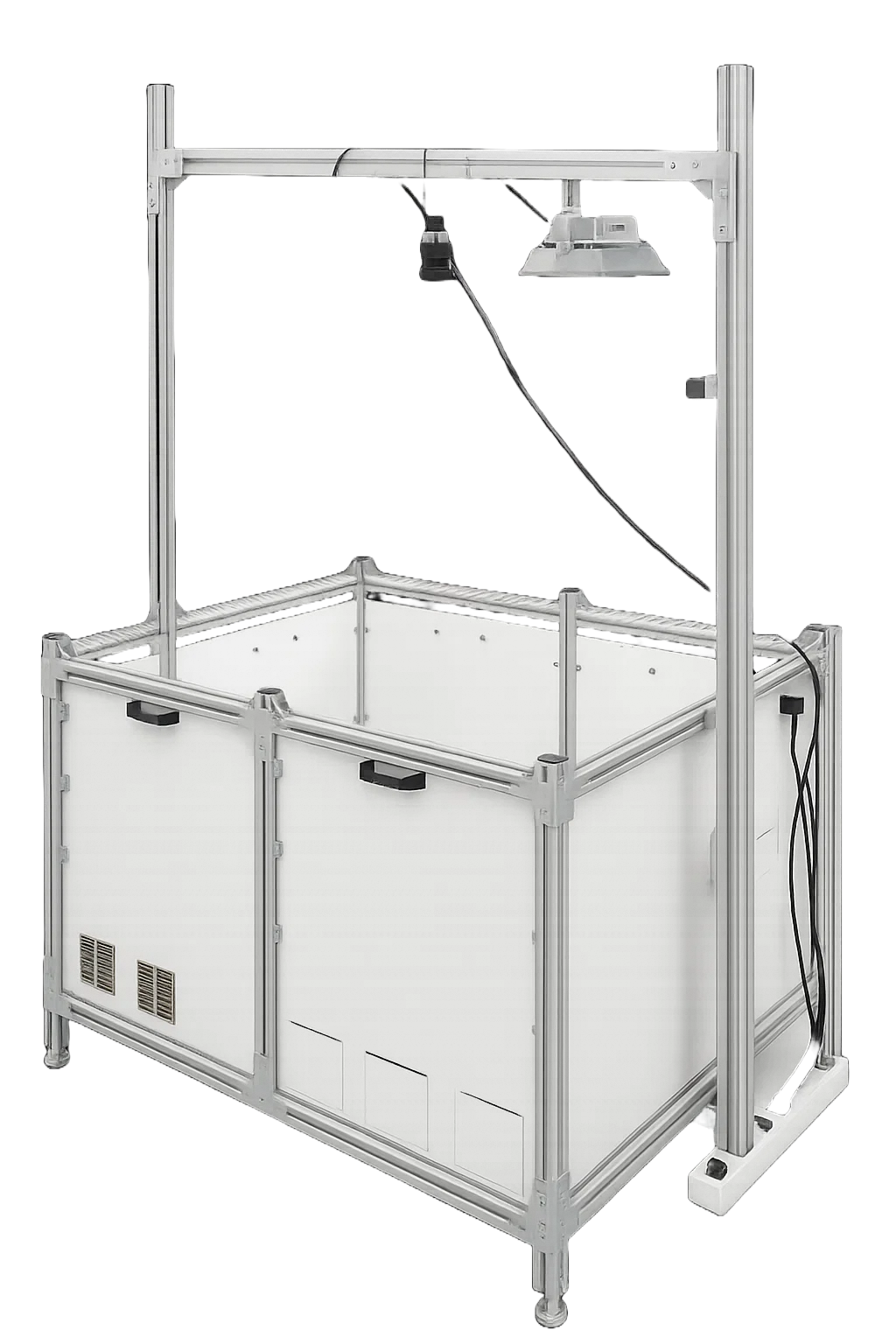
TruMouse Pro combines 144-channel RFID identity recognition with automated video analysis to track up to 20 individually identified mice simultaneously, in a 1.2m x 1.2m arena.
Existing tools force a trade-off between identity reliability and experimental scale.
In group-housed settings, video-only systems like DeepLabCut cannot reliably maintain individual identity across occlusions and crossings. Long-term experiments accumulate identity-switching errors that corrupt downstream analysis.
Most commercial behavioural systems are designed for single-animal paradigms or small groups. Scaling to colony-level experiments โ where social structure emerges โ has historically required manual observation or compromised tracking.
A 144-channel RFID floor array provides continuous, identity-certain localisation for up to 20 animals simultaneously โ resolving both problems within a single integrated system designed for long-term home-cage deployment.
Every output carries an identity label. Every identity label is RFID-verified.
144 reader units arranged in a 12 ร 12 grid beneath the arena floor. Each subcutaneously implanted tag is read continuously, providing ground-truth spatial position and identity for every animal โ regardless of occlusion or grouping.
Global-shutter industrial cameras with infrared illumination record high-frame-rate footage synchronised to RFID timestamps. A proprietary algorithm provides fast and accurate matching of identities to trajectories, while maintaining full compatibility with DeepLabCut.
A proprietary matching algorithm fuses RFID identity signals with video tracklets, producing a unified dataset where every pose, every trajectory, and every social interaction is attributed to a named individual. 41 metrics are computed automatically.
Native DeepLabCut compatibility. TruMouse Pro extends DLC's pose estimation with reliable identity labels โ addressing the identity-switching problem that limits DLC in group-housed settings.
Inspired by Live Mouse Tracker. Adopting a similar approach to this outstanding open-source paradigm, we deliver a complete, out-of-the-box solution so your laboratory can focus entirely on scientific research, freeing you from the burdens of hardware assembly and parameter troubleshooting.
Output is structured CSV and annotated video โ ready for direct import into Python, R, GraphPad Prism, or any downstream analysis tool.
TruMouse Pro was built to solve real experimental problems โ and extensively validated against them.
Running stably across 2 laboratories within the Institute of Biophysics (IBP), Chinese Academy of Sciences, with 3 systems in continuous operation.
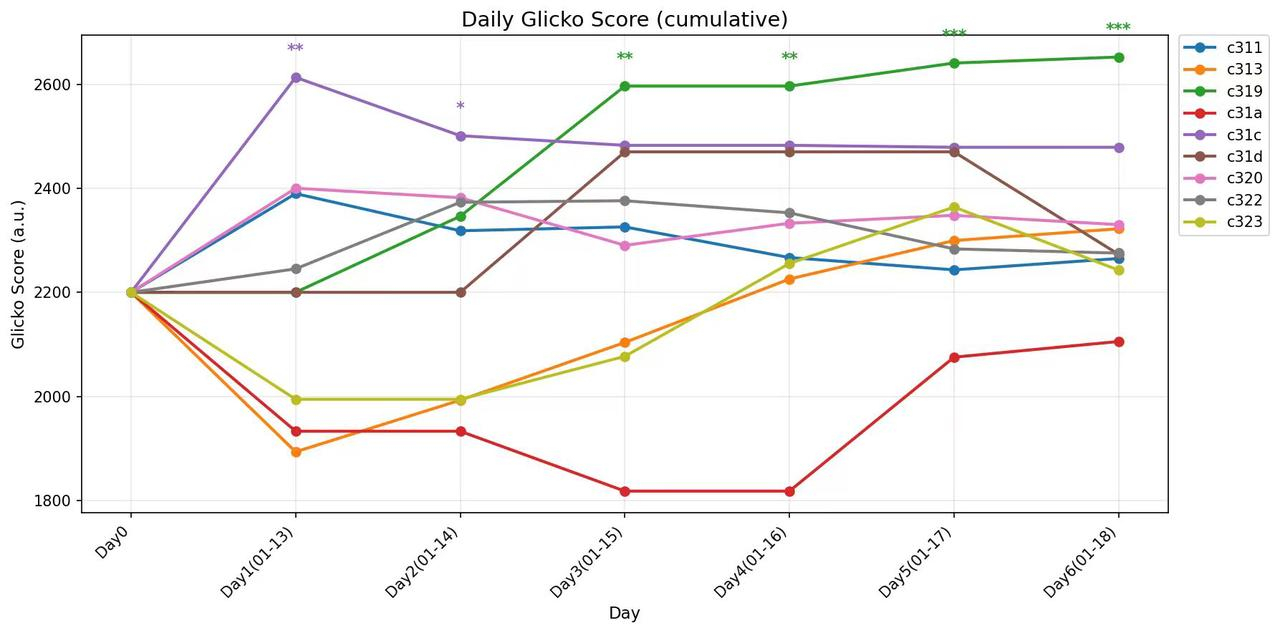
Glicko Score social hierarchy, 10 mice. Stable dominance ranking emerges within days of continuous home-cage recording โ replicating and extending the paradigm at larger colony scale. Data exported directly from the TruMouse Pro analysis pipeline.
The system was designed and iterated by a team with direct experience in long-term rodent behavioural studies. Every design decision โ from the RFID floor density to the output format โ reflects the practical constraints of real laboratory work.
The Pro version hardware architecture is engineered for year-scale continuous operation. The data transmission and power infrastructure has been validated for multi-week uninterrupted recording sessions.
TruMouse Pro builds upon and extends continuous tracking and behavioural analysis frameworks developed by the community.
Weissbrod, A., Shemesh, Y., et al. (2013). "Automated long-term tracking and social behavioural phenotyping of animal colonies within a semi-natural environment." Nature Communications, 4, 2018.
Shemesh, Y., et al. (2013). "High-order social interactions in groups of mice." eLife, 2, e00759.
de Chaumont, F., Ey, E., Torquet, N., et al. (2019). "Real-time analysis of the behaviour of groups of mice via a depth-sensing camera and machine learning." Nature Biomedical Engineering, 3, 930โ942.
Mathis, A., et al. (2018). "DeepLabCut: markerless pose estimation of user-defined body parts with deep learning." Nature Neuroscience, 21, 1281โ1289.
Gammell, M. P., et al. (2003). "David's score: a more appropriate dominance ranking method than Clutton-Brock et al.'s index." Animal Behaviour, 66(3), 601โ605.
Glickman, M. E. (1999). "Parameter estimation in large dynamic paired comparison experiments." Journal of the Royal Statistical Society: Series C (Applied Statistics), 48(3), 377โ394.
TruMouse Pro covers colony-scale behaviour. For single-animal assays and chronic stress modelling, we've built two complementary tools.
Zero-code desktop software for classical single-animal paradigms โ OFT, TST, NOR, EPM, Y-Maze. Batch video analysis, local processing, GPL-3.0 on GitHub.
Explore MouseScope โ ModelingAutomated chronic stress platform for depression and anxiety modelling. Supports CUMS and CRS protocols with programmable, unattended stress delivery.
Explore BlueBox โ